
Document folding in bulk mailing: how to match the fold to the envelope
Folding is not a final technical detail of a mailing. The fold type affects whether a document fits the envelope, the address stays in the right position and the complete set runs smoothly through automated inserting.
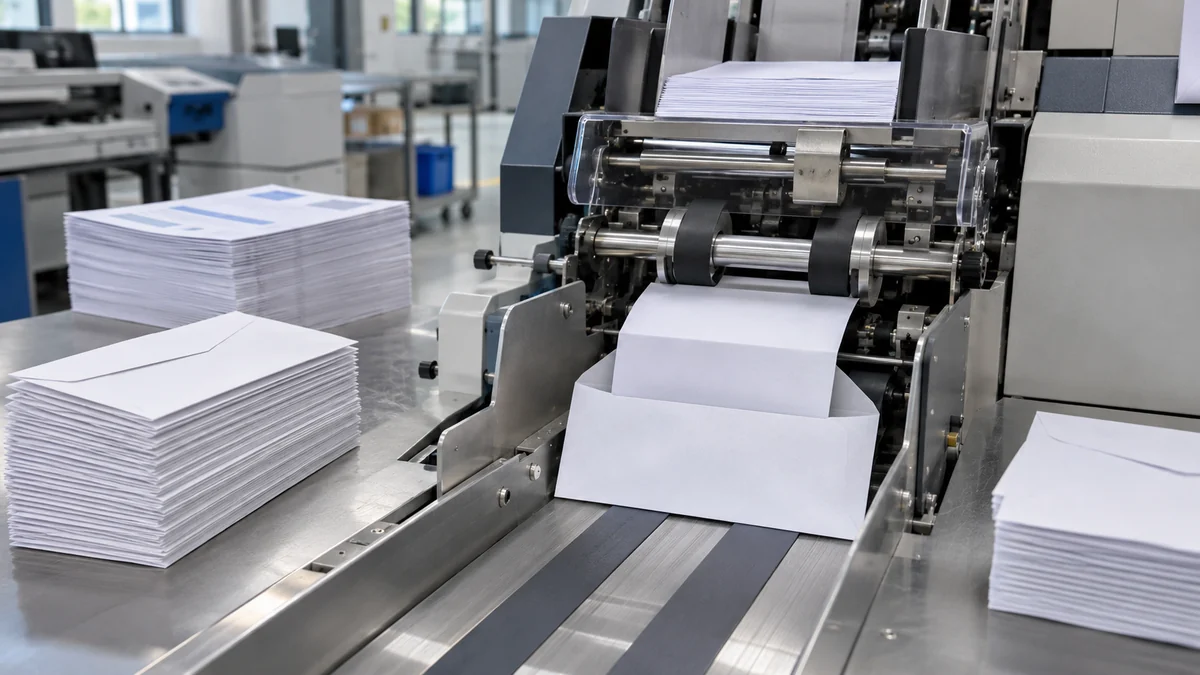
Folding belongs in the mailing specification
The fold must be agreed together with the envelope format, address position, page count and inserting method. If the decision is postponed until after printing, even a correct file may require manual repacking or rerunning production. A sound specification defines the finished insert size, feed direction and permitted set variants.
Start with the envelope and finished size
Common options include letter or C fold, Z fold, single or half fold and double parallel fold. Folding and inserting systems support different combinations, so the choice must be confirmed for the specific machine, envelope and document. The goal is not merely a straight crease but an insert that fits and remains correctly oriented.
Paper changes how the fold behaves
Weight, coating, stiffness, grain direction and the number of sheets affect crease quality and machine transport. Heavier or coated stock may require another setup and reduce the permitted sheet count. Settings should not be copied automatically from an earlier job - the sample must use the target paper.
Orientation determines readability and address position
After unfolding, the document should open in a natural reading order, while an address in a window envelope must remain visible despite insert movement. Check the outer and inner faces, text direction and which edge enters the envelope first. This test links file preparation with the real production path.
Variable sets require boundary cases
One batch may contain single-page letters, multi-page documents and mailpieces with inserts. The specification should state the maximum sheet count, permitted insert thickness and how sets outside the machine range will be handled. There is no universal capacity: it depends on the model, stock, envelope and job setup.
The sample must represent the whole batch
Before production, test the shortest and longest set, a set with an insert and samples from the beginning, middle and end of the file. Inspect fold position, creases and curled corners, page orientation, address visibility, envelope sealing and sheet count. Approving one easy sample does not validate the entire process.
Exceptions and reprints must remain recorded
A jam, incomplete fold or an over-thick set should enter a defined exception path. The record must remain linked to the decision to reprocess or make a controlled reprint. Manually adding documents outside the log makes it difficult to reconcile records, sheets, envelopes and spoilage.
The report closes the batch, not just the machine
At completion, compare input records with complete envelopes, exceptions, spoilage and reprints. The report should show what was completed, what needed intervention and whether every mailpiece was reconciled. Folding then remains part of a controlled process rather than an invisible operation between printing and dispatch.
BackOffice Outsourcing can manage the whole workflow
BackOffice Outsourcing provides data preparation, personalisation, printing, folding, envelope inserting, batch control and handover for dispatch. For each job we agree the documents, envelopes, set variants, sample and final report. The client receives one organised process instead of coordinating printing, fulfilment and reconciliation separately.
Sources
- Quadient - Folder inserters: fold types and the effect of paper weight
- Quadient DS-64i - Supported fold types are device-specific
- Pitney Bowes Relay - Folding, inserting and sealing workflows
- Formax FD 324 - Standard fold configurations and job settings
FAQ
Which fold type is best?
The one that matches the envelope, document layout and the specific machine. In practice, confirm the choice on a sample made with the target stock.
Can every paper be folded automatically?
Not in every setup. Weight, coating, stiffness and grain direction may affect crease quality and the permitted number of sheets.
How should variable page counts be controlled?
Define set variants, maximum thickness and exception rules, then test a short record, a long record and a set with an insert.
Why is a production sample necessary?
Only the target stock, envelope and machine reveal the actual fold position, orientation, address visibility and inserting performance.