
Bulk mailing with inserts: how to control the completeness of every envelope
As document and insert variants multiply, a sealed envelope can look correct while containing a missing or wrong attachment. Integrity control links data, marks and inserting results into one auditable process.
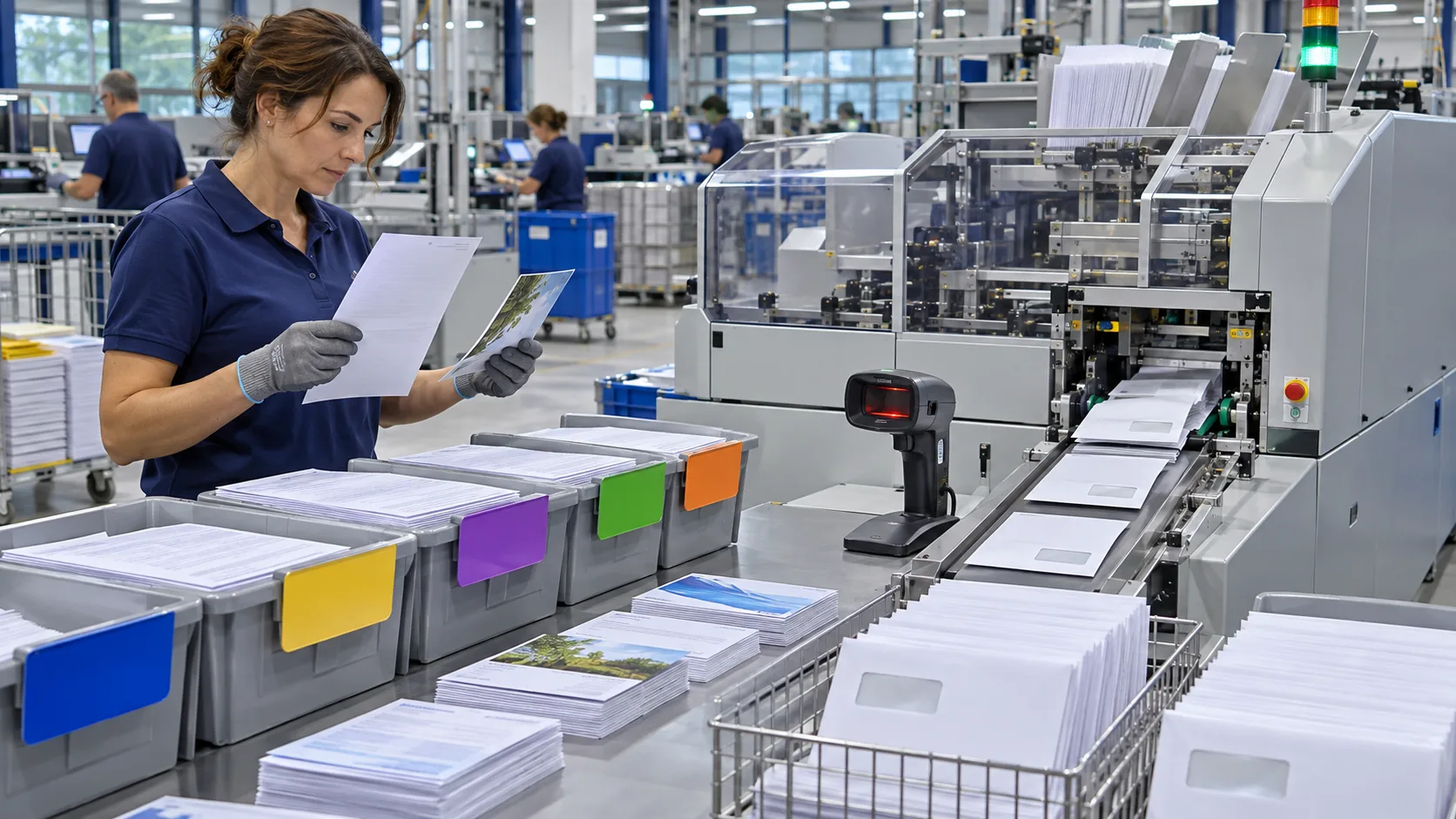
Define every permitted mail set
Before printing, create a version-controlled matrix covering the main document, page count, mandatory inserts, segment-dependent inserts and envelope type. Approve it before releasing the batch.
Use one identifier per mailpiece
The record or mailpiece identifier must remain consistent across the data file, document, control code and report. Page numbers alone do not prevent sheets from two recipients being combined; a set ID helps detect the boundary.
Control sequence and page count
OMR, 1D or 2D codes can carry page number, page total and set-ending instructions. The inserter should stop when a page is missing, sequence breaks or a code belongs to another job.
Separate fixed and conditional inserts
An insert added to every envelope needs different logic from an attachment selected by recipient data. For every feeder, define permitted variants, empty-feeder detection and evidence that the insert was picked.
Stop and investigate exceptions
A stop, double feed, unreadable code or damaged envelope must not end with a cleared alert. Record an exception ID, decision, any reprint and confirmation that only the correct set entered dispatch.
Reconcile production with the report
The final report should reconcile input records, correctly sealed envelopes, rejects, reprints and held items. Closed-loop systems create evidence that supports confirmation that the right documents reached the right envelopes.
The client benefit
BackOffice Outsourcing can handle data preparation, personalisation, printing, insert selection, automated inserting and dispatch. The client gets less manual work, a clear batch status and an exception report.
Źródła
FAQ
Does a barcode guarantee a correct envelope?
It is one control element. Effectiveness also depends on the rule, unique set ID, reader configuration and exception handling.
How should a universal leaflet be controlled?
Assign it to the batch rule, monitor the feeder and include its pick in the proof and production report.
What happens after a machine stop?
Isolate uncertain sets, identify the last correct ID, recheck sequence and document the restart.
What should the client receive?
Counts of records, good envelopes, rejects, reprints and holds, plus dispatch status and an agreed report through e-COK or another secure channel.