
Envelope weight control after inserting: detecting missing and double inserts
A finished envelope can look correct while still containing a missing insert or a duplicated document. Weight control after inserting helps flag deviations before dispatch and route exceptions for review.
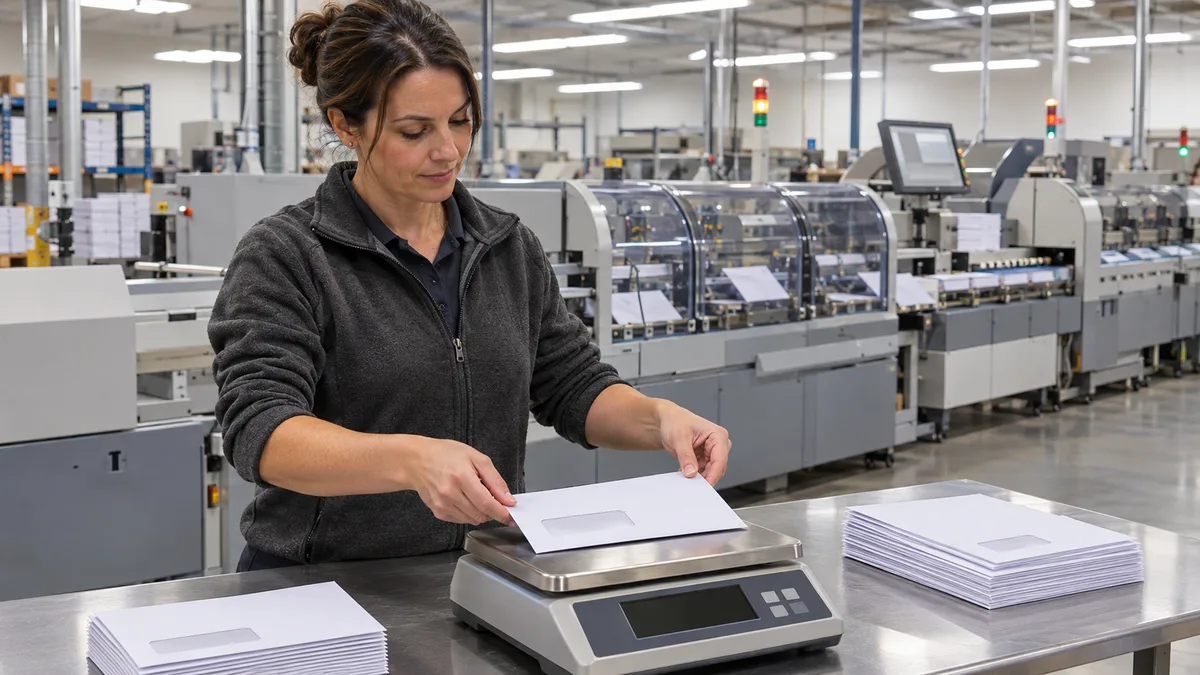
Weight is a supporting control, not the only evidence
A weight difference may reveal a missing sheet, a double insert, the wrong reply form or the wrong envelope. Weight alone does not confirm document identity. It should therefore be combined with record identifiers, page-count controls, OMR or 2D codes, double-feed detection and full batch reconciliation.
Define a reference for every envelope variant first
A bulk job is rarely uniform. One envelope may contain two pages, another six, and another an additional insert. Before production, define the expected contents and weight range for each variant. The reference should include paper, envelope, enclosures and a reasonable equipment tolerance.
A deviation should stop the exception, not the whole job
A useful control is not unplanned manual weighing of every envelope. Mailpieces outside the agreed range are routed to an exception queue. The operator checks the identifier, page count, inserts and seal, then records whether the piece is accepted, corrected or produced again.
Combine weighing with double-feed detection
Inserter manufacturers describe controls that detect two sheets or inserts being fed together. This operates earlier than weighing the finished envelope and can stop an error at the feeder. End-of-process weight control adds another barrier, especially when sets contain variable pages or several enclosure types.
Start-up samples reduce false alarms
Before the full run, prepare samples of every variant. Check completeness, folds, address position, envelope seal and weight. Only then define control ranges. A tolerance that is too narrow creates unnecessary exceptions, while one that is too broad may fail to detect a genuine omission.
Reconcile accepted and rejected mailpieces
At completion, the input record count should equal accepted envelopes plus exceptions, rejects and reproduced pieces. Every envelope rejected by the weight rule needs a final status. A scale report alone is not evidence that the mailing is complete.
What to give your mailing partner
Provide the variant structure, insert rules, expected page counts, record identifiers and exception-handling rules. BackOffice Outsourcing can prepare personalisation, printing, inserting and batch controls within the agreed scope. Contact us to match the control plan to your documents and volume.
Sources and technical materials
The controls described here combine practical batch reconciliation with document-integrity functions used in inserting equipment.
Explore document printing and envelope inserting
Want fewer manual corrections and clearer batch reconciliation? Talk to us about personalisation, printing, inserting and controls matched to your documents.
Explore document printing and envelope insertingFAQ
Does weight control replace OMR or 2D codes?
No. Weight detects a mass deviation but does not confirm that the envelope contains the correct recipient’s document. Several controls work best together.
Must every envelope be weighed individually?
It depends on risk, set variability and process equipment. All pieces, selected streams or samples may be checked, but the rule should be agreed before production.
What happens to an envelope outside the weight range?
It should be separated, its identifier and contents checked, the decision recorded, and only then accepted or reproduced.
Does a different weight always mean an error?
No. A justified page count, insert or envelope type may change the weight, so ranges are defined separately for known variants.